4. Profle
4. Profile of the Region
Ulster County has a rich natural, cultural, and commercial history that continues to evolve. The County has experienced reoccurring periods of significant growth followed by subsequent decline and recovery since its settlement in the early 1600’s. The region continues to improve its economic outlook as evidenced by increases in employment, improvements in the real estate market, and increases in sales and hotel tax receipts and the strengthening of its ties to the New York Metropolitan area. However, municipal tax caps and lack of growth in personal income continue to place strains on both municipal and family budgets with increases in housing costs outpacing income growth.
Transportation availability and cost is also a major concern for many households. This underscores the need to rethink how mobility can be improved within municipal and family budgets in a manner that allows the region to remain competitive and sustainable.
Population
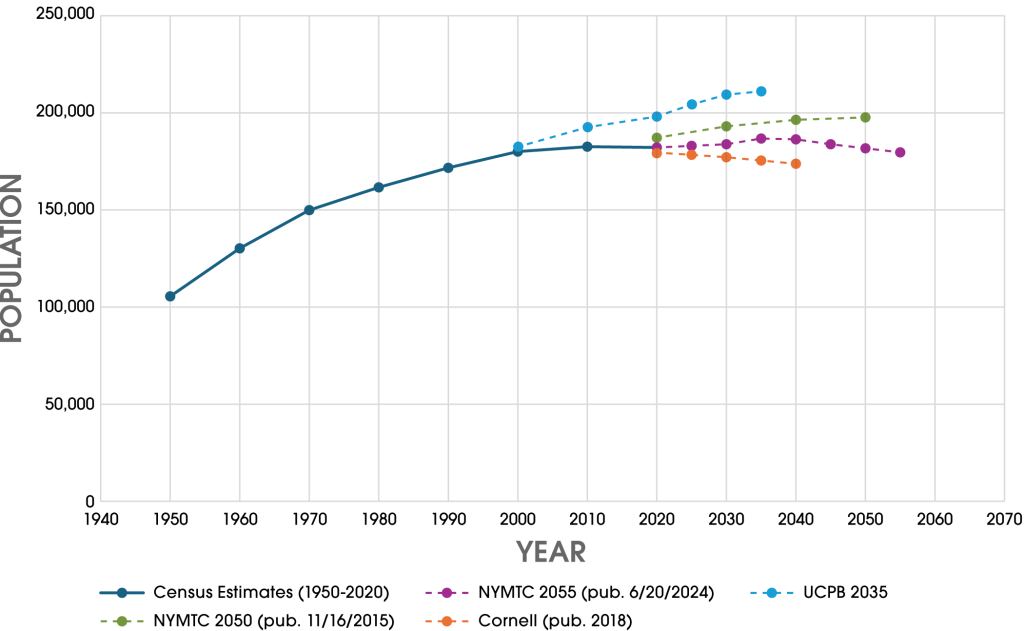
According to the 2023 American Community Survey – the latest estimate of demographic statistics available – the population of Ulster County is estimated at 182,109, which is up 2.1% since the 2020 Census but generally in line with the population estimates from the 2010 Census.
An overview of historic population trends in Ulster County reveals steady but declining growth rate from 1950 through to the 2010 decennial census. A strong 28% increase between 1950 and 1960 stands in stark contrast to the less than 3% increase between 2000 and 2010 (Figure 4.2) and the estimated 2.3% decline between 2010 and 2020. The population recovered in the postCovid era with a 2.1% increase between 2020 and 2023 to almost match 2010 population levels.
An overall declining rate of population growth can be attributed to four primary factors: mortality, out-migration among older adults, a declining birth rate, and an inability to retain young people as they enter adulthood.
It is challenging to predict Ulster County’s population over several decades with any level of certainty. In general areas south of New Paltz are likely to see increases in population over time due to proximity to employment centers outside of the County while the City of Kingston area enjoys renewed interest due to costs, quality of life, and opportunities for networking with others from the metropolitan area.
Title VI Demographic Characteristics
Labor and Employment
Unemployment rate in the Kingston Metropolitan Statistical Area (MSA), which includes the entirety of Ulster County, remains below the state rate and has continued to improve since the pandemic. Concurrently, however, the County’s labor force has decreased slightly since 2018, very likely a result of out-migration as well as from retirements as people age and chronically unemployed workers permanently dropping out of the labor force. As described by the New York State Department of Labor (DOL) in their monthly labor profile for the Hudson Valley, for the 12-month period ending in January 2025, private sector employment in the Hudson Valley increased by 15,200 or 1.9 percent, to 819,000.
Lorem ipsum dolor sit amet, consectetur adipiscing elit. Ut elit tellus, luctus nec ullamcorper mattis, pulvinar dapibus leo.